Tart cherry extract vs juice: which is actually worth buying?

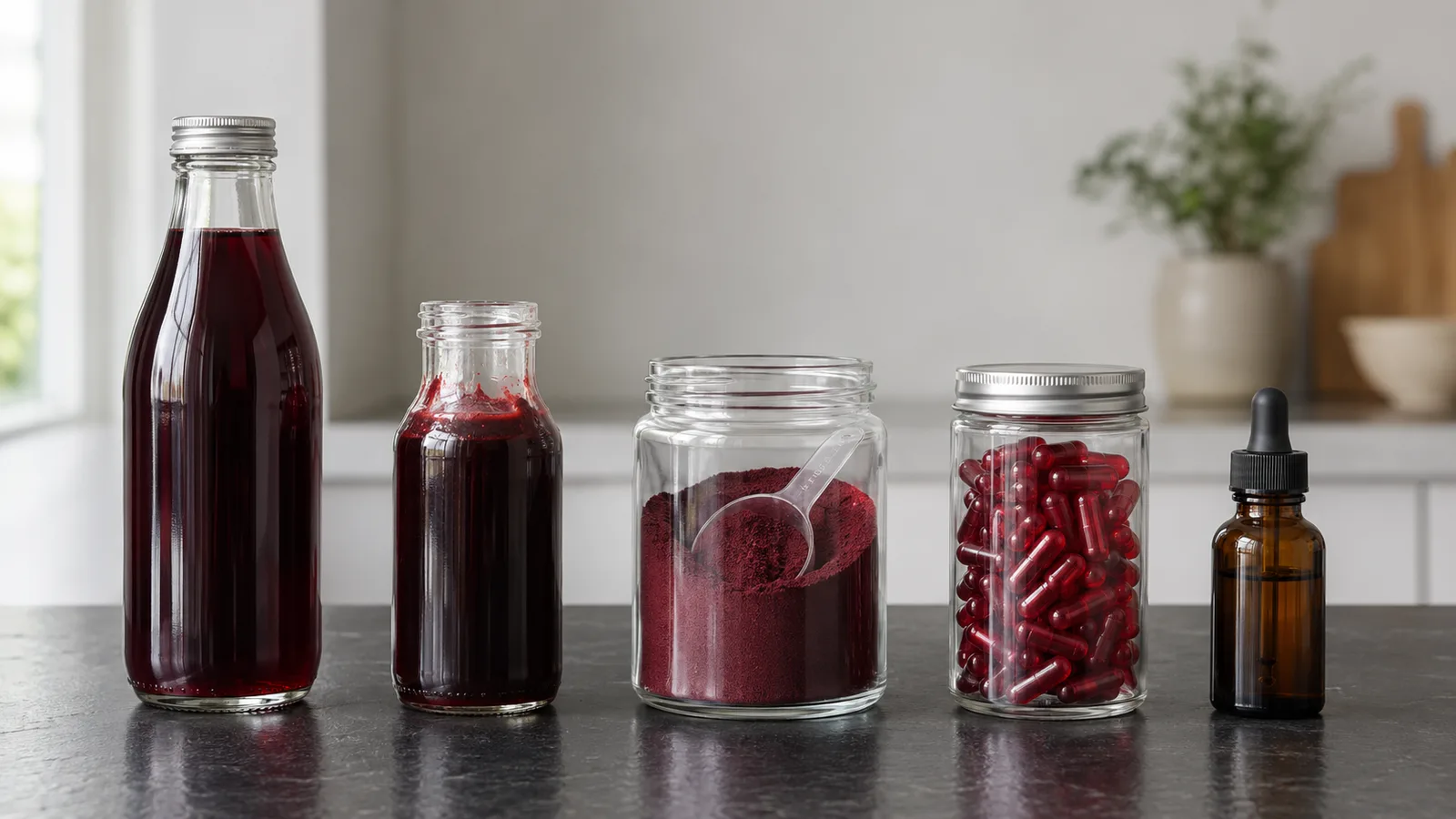
Juice has the research behind it. Extract has the practicality. Most of the sleep trials used juice from concentrate, so that is where the evidence sits, but the protocol is 16 oz a day with real sugar in it, which is why so few people stick with it. The right choice depends on which of those two problems you would rather have.
The five formats on the shelf are usually presented as the same thing at different price points. They are not. They differ in the one thing that decides whether any of this works: how much of the active compounds you actually get, reliably, every night.
The five formats, honestly compared
| Format | Studied? | Dose you can verify | Main drawback |
|---|---|---|---|
| Juice from concentrate | Yes, most trials | Varies by brand and harvest | 16 oz/day, sugar, bathroom trips |
| Ready-to-drink juice | Partly | Often diluted or blended | Frequently mostly apple juice |
| Powder | Yes, and one trial found nothing | Usually stated in mg | Mixing, taste, variable potency |
| Capsules | Some (~480 mg extract) | Stated on label | Swallowing pills; slower absorption |
| Liquid drops | Little direct research | Stated, but varies widely | Newest format, least studied |
The case for juice
If you want to do what the studies did, you drink the juice. That is the honest position. The seven-day trial that found more total sleep time and better sleep efficiency used juice from concentrate. The two-week trial in older adults that reported 84 extra minutes of sleep used juice.
The clinical protocol is fairly consistent: about 30 ml of concentrate diluted in water, twice a day (morning and evening) or roughly 8 oz of prepared juice per serving. One serving lands 60-90 minutes before bed.
Juice also carries the whole fruit matrix rather than an isolated fraction: anthocyanins, tryptophan, potassium and the rest. Since nobody has definitively identified which compound does the work, and it may well be several acting together, there is a reasonable argument for taking the form that was tested rather than a fraction of it.
The case against juice, which is mostly practical
Four problems, and they compound.
- Volume. Sixteen ounces a day is a lot of liquid, and the evening serving lands in exactly the window where extra fluid means getting up in the night. For people whose complaint is waking at 3am, that is an uncomfortable trade.
- Sugar. Tart cherry juice carries real fruit sugar, and the trial dose means drinking it daily. That adds up, and it matters more if you are watching intake for other reasons.
- Dose you cannot verify. Melatonin and anthocyanin content vary by cultivar, harvest, processing and storage. Montmorency cherries carry substantially more melatonin than other tart varieties, and concentrate carries roughly ten times more than raw fruit. The bottle rarely tells you where yours sits.
- Cost and spoilage. It needs refrigerating, it goes off, and the daily protocol is not cheap.
The case for concentrated formats
Powder, capsules and drops exist to solve the volume and sugar problems. They deliver the cherry compounds without asking you to drink a pint before bed, and they generally state a dose in milligrams that stays the same from bottle to bottle, which is the thing juice cannot promise.
That consistency is not a small point. If you are running the two-week trial on yourself, a dose that varies week to week makes the result impossible to read.
But here is the finding that should temper any enthusiasm: a 2024 trial using a commonly sold dose of Montmorency tart cherry powder in adults with overweight or obesity found no improvement in sleep or inflammation. One negative trial does not settle the question, and that population may respond differently. But anyone claiming concentrated formats are simply the better version of juice is not accounting for it.
What to check on any label
Regardless of format, these four things separate a product you can evaluate from one you cannot.
- Cultivar named. "Montmorency" is the variety used in most of the research. "Tart cherry" alone tells you less.
- A dose in milligrams, not "proprietary blend". A blend that hides the split between ingredients is a blend you cannot compare to a study.
- Extract ratio or anthocyanin content, where it is an extract. Without it, "cherry extract" could mean almost anything.
- Third-party testing. Supplements are not pre-approved for content accuracy, so independent verification is the only external check there is.
So which should you buy?
A reasonable way to decide, given what the evidence supports:
Start with juice if you want to replicate what was studied, you do not mind the volume, sugar is not a concern, and your problem is falling asleep rather than staying asleep. Give it the full two weeks at the trial dose before judging.
Consider a concentrated format if the evening liquid is self-defeating for you, which it is for most people whose complaint is waking in the night, or if you want a dose you can hold constant while you test whether this does anything for you at all.
Liquid drops sit at the newest end of this, and are the format with the least direct research behind them. What they offer is the concentrated dose without pills or mixing, held under the tongue rather than swallowed. Some formulas in that category also pair cherry with other sleep compounds: magnesium, L-theanine, low-dose melatonin. The systematic reviews list these as reasonable alternatives to high-dose melatonin on their own. Whether a combination outperforms cherry alone has not been tested in the trials we have.
If you go that route, the label checks above are the whole game: cultivar named, dose in milligrams rather than a proprietary blend, and any melatonin stated as a number you can compare against the 0.5-1 mg the evidence supports.
And if you have already worked through formats without much changing, it may be worth stepping back from the shelf altogether. Format is a small variable next to the reason your sleep broke in the first place, which for most people over 45 is not a missing ingredient.
3:41 the hour that repeats What if the format was never the problem? Juice, powder, capsules, drops. If you have worked through the shelf and your nights have not changed, a sleep researcher makes the case that the whole category aims at the wrong half of the night, and shows which half actually breaks. Watch the full account → Free video from an outside source, hosted on their site. It runs long and ends with an offer. We earn a commission if you buy, which does not change a word of what is written above.Related reading
Before starting anything, the timeline in how long tart cherry takes to work will save you quitting on day three.
And if you are already taking a melatonin tablet, read can you take tart cherry and melatonin together first. The dose math is not what most people expect.
Common questions
Is tart cherry extract stronger than juice?
More concentrated per milliliter, yes. Whether that translates into a better outcome is a different question, and the one negative powder trial suggests concentration alone does not guarantee an effect.
Can I just eat fresh cherries instead?
You would need a very large quantity. 100 g of Montmorency cherries carries roughly 0.00135 mg of melatonin, a fraction of a juice serving. Fresh fruit is excellent food; it is not the studied intervention.
Does sweet cherry juice work the same way?
No. Tart varieties carry considerably more melatonin than sweet ones, and Montmorency more than most other tart varieties. The research is specifically on tart cherry.
Are capsules or drops absorbed better?
Manufacturers make various claims here, and absorption figures quoted on sales pages are rarely supported by published data on the finished product. Treat specific absorption percentages with skepticism unless there is a study behind them.
Sources
Howatson G. et al., European Journal of Nutrition · Commonly used dose of Montmorency tart cherry powder does not improve sleep or inflammation outcomes, 2024 · The effect of tart cherry on sleep quality and sleep disorders: a systematic review, Food Science & Nutrition, 2025 · Cleveland Clinic, tart cherry juice and sleep · Sleep Foundation, tart cherry juice · Examine.com, tart cherry juice dosage and side effects.